[Week 2] Weekly Reflection- Sept 18th, 2026
Kaitlyn Tuck September 18th, 2026
This week’s article and documentary pulled me in two directions which were about the same topic of conversation. Our first reading, Alpha School, which was produced and written by The Scientific Amercican, talked about whether AI can and should take over teachers’ jobs. Most Likely to Succeed was the documentary we watched, which examined a system where there were no standarized tests, homework, textbooks, and was led solely by the students’ creativity and imagination with the guided support of the teachers. The school documented in the video was called High Tech High where the focus shifted from the traditional, standardized learning of regular subjects such as English and Math and instead, focused on preparing the students to have real life skills instead. The debated question here is whether we should be shifting to a school system that follows High Tech High’s curriculum and has a higher reliance on AI, or if the traditional ways of learning are still what’s best for shaping the young minds of the next generations to come.
“If we teach today as we taught yesterday, we rob our children of tomorrow” was John Dewey’s opening words in Most Likely to Succeed. Dewey’s thoughts on the philosphy of education is set on the idea that it should not be a continuous preparation for future life, but rather, driven by hands on experience, critical thinking, and active participation within society. For instance, Tony Wager stated in Most Likely to Succeed that “kids are spending way too much time studying for tests which don’t teach us about community and greater things in the world.” There’s concerns that schools are missing the bigger picture to what the future has to offer that differs from the pressure of a letter grade or how well you understand a topic.
From a cultural stance, the critiques from the documentary all stemmed from a economical point of view. “53% of college graduates are unemployed or in jobs that are not a first pick choice.” Even the students who are graduates from high ranked universities such as Harvard and Cornell “are coming out of school and only being able to work for their parents”. Most Likely to Succeed wants us to now look at the complications arising from when the Committee of Ten, who were in charge of coming up with a standard set of subjects every kid should know. Their priorities were decided years ago in a time when our economy was very different than what it is now. The saying here is that if the economy is different nowadays, why can’t the structure of a school’s curriculum and ways of operating change as well.
A concern of mine that I kept regularly going back to that started circulating in my mind is how do universities actually perceive kids coming out of High Tech High or do they even consider them as viable candidates? There were multiple parents in the documentary that were highly concerned about how their kids were going to make it into university when “there are no textbooks, no teacher standing at the front of the room being an authority figure, and no kid that seemed to know basic geography?” You could say that I am biased by agreeing with the parents because I’ve been trained to see school as “a game you have to play in order to get to places in the future” (Most Likely to Succeed), so their concerns resonated with me. However, part of me agrees that if university admissions are based off of things such as transcripts, GPA, and standardized testing that does not account for any critical thinking, then school that follows a similar system as High Tech High is at a disadvantage. For instance, a student graduating from High Tech High could be very well rounded with different capabilities than those who are considered the traditionally ‘smart’ people, but they would still be at a disadvantage because the majority of universities have not updated or broadened their admission criteria. When looking at the advanced creativity of the kids had at High Tech High, as shown through their exhibition project, it allowed me to see that perhaps intelligence is not best measured by grades or academic performance, but instead, by what students can create. For example, the projects the kids were making in the documentary I could not make even as a second year university student. I am at a disadvantage because I’ve never had the opportunity to have a sufficient amount of time, let alone encouragement, to simply focus on the creative process.
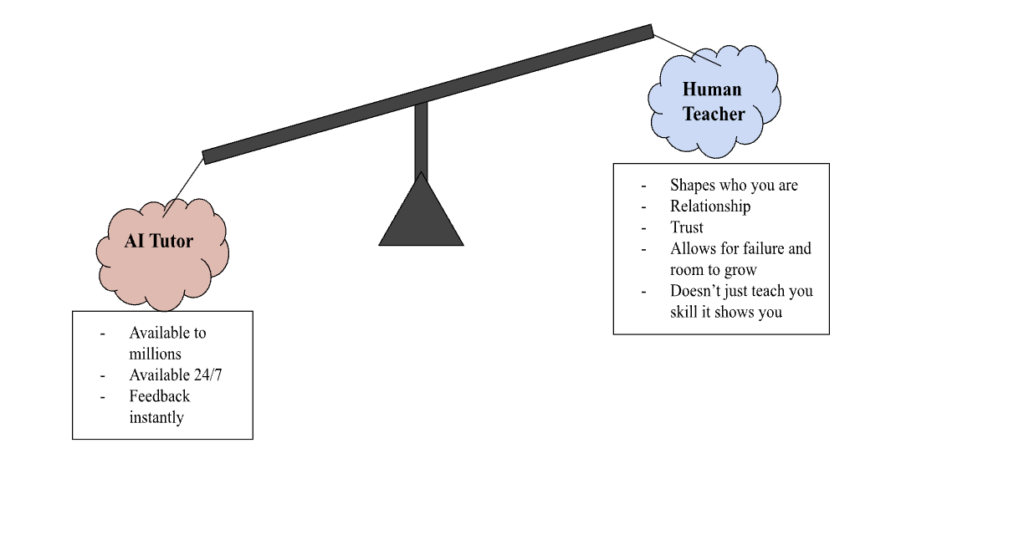
Lastly, I want to circle back to the Alpha School article to finish off my reflection. In the article, their advocacy to replace traditional classroom teaching with artificial intelligence was quite concerning for people including myself. “Without a teacher-student relationship, what’s the point?” is what Kelly Miller questioned in the article. However, my professor, Collin, answered that question in class today by saying “people wouldn’t be where they are today without teachers.” After he said that, he began by using lawyers as an example and explained that someone does not just become a lawyer by reading case law or being fed information. They had to be taught by someone who teaches them how to think, act, question their reasoning, and be truly passionate about setting them up for success. That is the same with any other profession whether that be doctors, nurses, engineers, or any others whose professions are at risk of being overtaken by artificial intelligence.
At the end of the day, my thoughts on this issue all tie back to the question of whether AI, if it acts as a tutor, can do what a teacher does to the same extent? For me, this means not just having the correct information handed to me by a classroom instructor, but also being taught with raw, interactive engagement, which I believe only a physical teacher can provide. Carl Hendrick stated that training AI will allow it to “eventually handle any eventuality” which was then compared to how self-driving cars have evolved. Although I agree that AI can scale and effectively produce information, what AI cannot do is scale the tactics, emotion, passion, and skill that have made every person in today’s world good at their jobs in the first place well before the existence of AI.
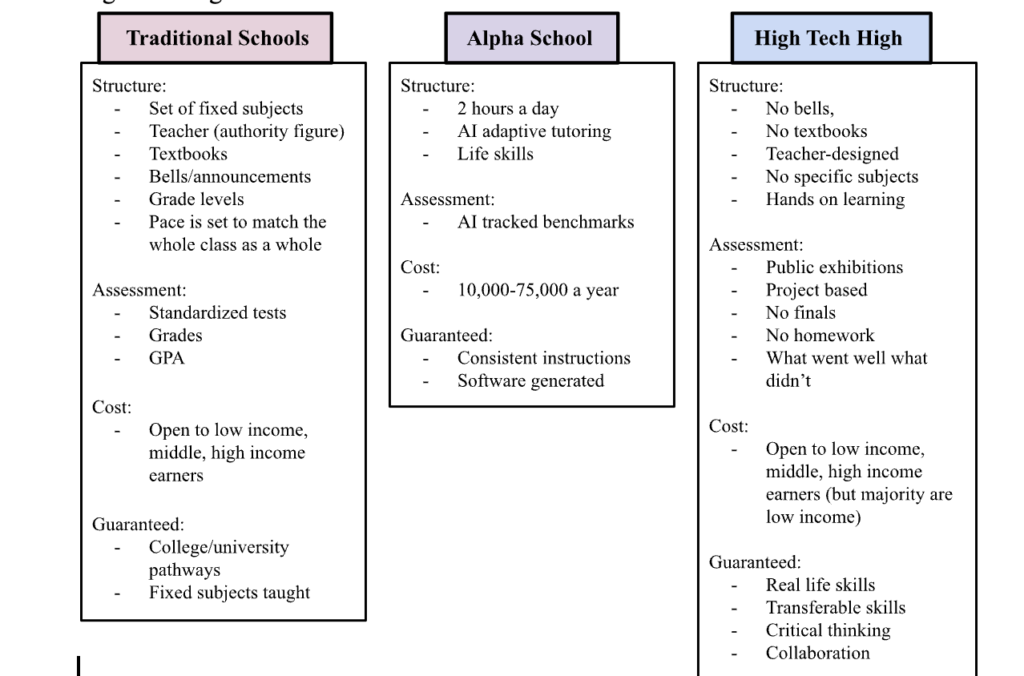
My Multimedia Model :
Down below shows my multimedia model as I went and made a colum putting together all three different perspectives/models of schooling together. From this you can clearly see right off the bat that Alpha School does not have much to offer compared to traditional schools and even High tech High.
This leads into the other diagram I made that addresses the article Alpha School:
Note: I did this on a word document first which is why I was able to create multimedia images and incorporate them onto this blog.